Operatory management sounds like a software category. It is not. It is four decisions a practice makes every day, mostly without noticing, and the quality of those four decisions is most of the difference between a practice that finishes at five and one that finishes at ten past six with two people annoyed.
This guide takes them one at a time, says what to measure for each, and gives a weekly routine that takes about twenty minutes. It assumes you run Open Dental and have no additional software, and it tells you where the manual version stops being reasonable.
Decision one: which room each provider and procedure gets
Most practices assign rooms by habit. The hygienist is in OP-1 because she has always been in OP-1, and the room with the good light is where the doctor does anteriors. Habit is a perfectly respectable system, and it is worth checking once a year against three questions.
Does every room have a rostered owner for every hour it is open? A room with nobody assigned is still capacity you are paying for — it counts in your utilization either way, which is what keeps it visible — but it is not capacity you can book, and a schedule that treats it as bookable produces a plan nobody can staff.
Does the equipment match the work? A room without the scanner is a room where half your treatment plans cost an extra walk. That walk shows up later as turnover time and nobody connects the two.
Does one room take all the long procedures? If so, its utilization will look excellent and its turnover will look terrible, and both figures will be misleading until you separate them by procedure type.
Decision two: how fast rooms turn over
The operational gap is from checkout in one room to the next patient’s recorded arrival or seating time there. It can show a gap between patients, but it is not a measurement of cleaning, sterilization, or other room-reset work.
Measure the process you want to improve before changing it. A manual room-reset study needs its own timestamps; the checkout-to-next-arrival-or-seating gap alone is not a sterilization measure.
Worked example, with numbers chosen to be plausible rather than measured. A four-operatory practice finds an average turnover of 14 minutes across 32 patient visits a day. That is roughly seven and a half hours of chair time a day spent on rooms being reset, spread across four rooms. Cutting the average to 10 minutes gives back a little over two hours of chair time a day across the practice. Whether that is worth chasing depends on whether you can fill it, which is decision four.
The useful part of the exercise is rarely the average. It is the shape. Turnover that is 9 minutes at nine o’clock and 22 minutes at eleven is not a turnover problem, it is a staffing-cover problem at eleven, and no amount of encouraging people to move faster will touch it.
Decision three: how the schedule is paced
Pacing is whether the work you booked can be done in the time you gave it, in the order you gave it. Two practices with identical daily production can have completely different days depending on how the long procedures are distributed.
Three things are worth watching.
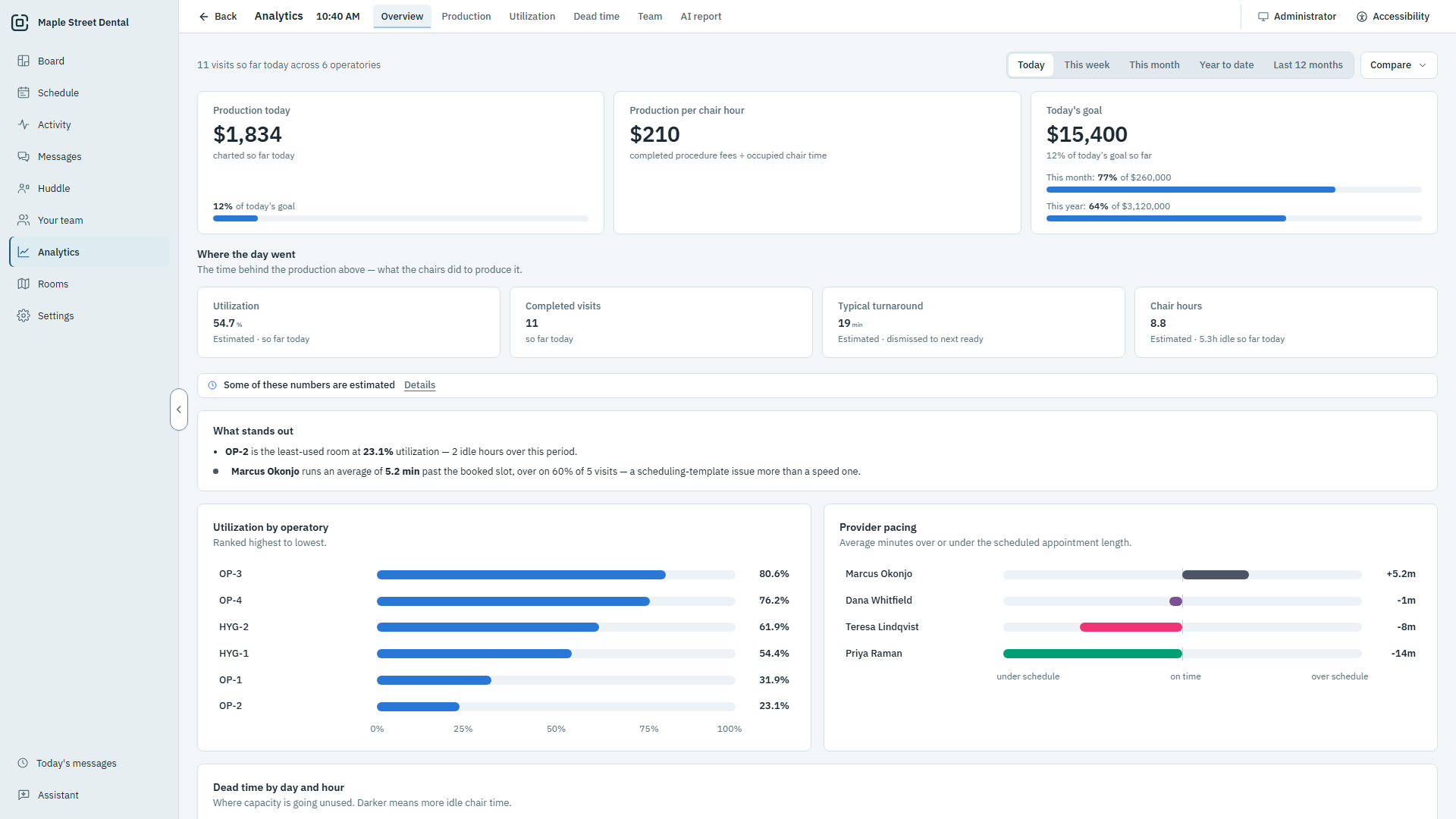
On-time starts. The share of appointments seated within a few minutes of their scheduled time. This degrades through the day, and the rate at which it degrades is more informative than the average. A practice that starts 85% of morning appointments on time and 40% of afternoon ones has a specific problem at a specific hour.
Average minutes past scheduled end, by procedure type. If your hour-long crowns reliably take 75 minutes, the answer is not to work faster. It is to book 75 minutes. This is the single most common finding when a practice measures itself for the first time, and it is the easiest to fix.
Where the day’s slack is. Every schedule has recovery points, usually a short gap or a flexible hygiene column. Knowing where the next one is tells the front desk whether a 20-minute overrun at ten o’clock will be absorbed by lunch or will still be there at four.
Decision four: which bottleneck to fix first
Practices usually know their bottleneck is somewhere and pick the wrong one, because the visible problem is downstream of the real one. A few patterns worth recognizing.
The doctor is the bottleneck, and the rooms are waiting. Rooms sit occupied with a seated patient and no provider. The timer that catches this is elapsed-in-chair on rooms with no procedure in progress, and the fix is usually a change to how many rooms one provider is running, not a change to anyone’s speed.
The rooms are the bottleneck, and the doctor is waiting. The opposite shape: providers idle between patients while every room is being reset. The fix is assistant cover, and it is the pattern that a turnover-by-hour breakdown makes obvious in about a minute.
The front is the bottleneck. Patients arrive on time and are seated late, with rooms free. This shows up as a waiting room count that stays high while ready rooms exist, and it is almost always a check-in workflow issue rather than anything clinical.
Nothing is the bottleneck, and the schedule is just full. This is a real answer, and the practices that reach it stop trying to squeeze the day and start looking at hours instead. That is a capacity question, which is a different exercise.
A weekly routine that takes twenty minutes
Once a week, at the same time, look at four things and write down one sentence about each.
- Utilization by operatory for the week. Not the practice average. The room-by-room figure is where the surprises are.
- Average turnover by hour of the day.
- On-time start rate, morning against afternoon.
- Average minutes past scheduled end for your three most common procedure codes.
Then pick one thing to change and check it again the following week. Four numbers and one change is a routine a practice can actually sustain. Twelve numbers and a plan is a routine that lasts three weeks.
Where the manual version runs out
Everything above can be done with a clipboard, and for a two-week study it should be, because two weeks of your own numbers will tell you more than any article can. What a clipboard cannot do is week thirty-one. Manual measurement decays, and it decays fastest on the busiest days, which are the days you most need measured.
That is the point at which the measurement has to come from something nobody has to remember. OperatoryView reads Open Dental through Open Dental’s API, read-only, and turns the appointments your team is already recording into the Board and a history: utilization by room, dead time by day and hour, turnaround, pacing against the booked time, and where the day is likely to run over.
See your Open Dental practice live.
Put every operatory on the Board on every office PC, message a room from a right-click, and measure what actually happened.