Most practices have tried a morning huddle. A good number have quietly stopped. The usual reason is not that the team disliked it; it is that the meeting turned into ten minutes of reading the schedule out loud, and everyone already had the schedule.
A huddle earns its place when the team leaves it knowing something the schedule does not say. That is the whole test, and everything below is in service of it.
Set the frame first
Ten minutes, standing, same time every day. If it needs chairs it will run twenty minutes. If it moves around it will be missed.
Before the first patient, not after. A huddle held once the day has started is a status report.
Everyone who touches the day is there. Providers, hygienists, assistants, and the front desk. The front desk is the one most often left out and the one with the most to contribute, because they hold the arrivals, the confirmations and the open slots.
One person runs it. Usually the office manager. It is a facilitation job, not a seniority job.
No clinical detail beyond what the day needs. Room, provider, procedure, timing. A huddle is an operations meeting and does not need to become a case review.
A ten-minute agenda
1. The shape of the day (1 minute)
Not a patient list. Three or four facts: how many appointments, how many booked chair hours, what time the first patient is in and what time the last one is out, and which rooms are in use. This tells everyone how heavy the day is before anyone hears a single name.
2. Where the day is likely to run long (3 minutes)
This is the part that makes a huddle worth attending, and the part most huddles skip.
The schedule says what was planned. Experience says which parts of the plan are optimistic. If the same procedure has run fifteen minutes past its booked length every time this month, then the schedule is wrong about it again today, and the team can say so at eight in the morning instead of discovering it at eleven.
Name the two or three appointments most likely to overrun and say what happens if they do: who waits, which room backs up, whether the afternoon absorbs it.
3. Provider pacing and load (2 minutes)
How the day is distributed. One provider with a compressed morning and an empty afternoon is a different day from one that is evenly spread, and the response is different too.
This is not a scoreboard. It is a heads-up: “you have four back-to-back before lunch, and the eleven o’clock is the one that usually runs over.”
4. Gaps and today’s opportunities (2 minutes)
Open slots, hygiene hours still unfilled, and any room that has nothing in it for part of the day. Say them out loud while there is still time to fill them. An open slot named at 8 a.m. is a phone call. The same slot noticed at 2 p.m. is a hole.
5. Yesterday, briefly (1 minute)
One or two facts, not a post-mortem. How far behind the day ran, or how many rooms sat idle, or how long turnover took. The point is the trend, and the trend only works if it is the same measure every morning.
6. Anything that changes the day (1 minute)
A team member out, equipment down, a delivery, a room unavailable. Last, and short.
Bring numbers, not adjectives
The difference between a huddle people attend and one they endure is whether the statements are specific.
“We were busy yesterday” is an adjective. “We ran 41 minutes behind by four o’clock, and it started with the ten-thirty in operatory 3” is a fact, and it points at something.
A short, fixed set of figures, said the same way every morning, is enough:
- Appointments today, and booked chair hours
- First patient in, last patient out
- Open slots and unfilled hygiene hours
- The procedures most likely to run past their booked time today
- How far behind yesterday ran, and where it started
The list stays the same every day. Consistency is what turns numbers into a trend the team can feel.
A worked example
Example numbers, illustrating the shape rather than a target.
Today. 34 appointments, 27.5 booked chair hours across 4 operatories. First in 8:00, last out 4:40.
Likely overruns. Two crown seats booked at 60 minutes; the last six have averaged 74. If both run true to form, operatory 2 is 28 minutes behind by lunch.
Pacing. Dr. A has five back-to-back appointments before noon and a light afternoon. The two-fifteen is the natural place to absorb an overrun.
Gaps. 3.5 hygiene hours open on Thursday. Two slots open today at 1:00 and 3:20.
Yesterday. Ran 41 minutes behind by close. Typical turnaround 16 minutes, up from 13 last week; operatory 4 was the slowest.
Read aloud, that is under two minutes, and every line is something a person can act on before nine o’clock.
The habits that kill a huddle
Reading the schedule out. Everyone can read. Say what the schedule does not.
Letting it become a complaint session. One problem raised is useful; three is a different meeting. Take the third one offline.
Praise and criticism aimed at individuals. A huddle is about the day, not about people. The moment it becomes a performance review, attendance becomes reluctant and honesty disappears.
Different numbers every morning. If Monday’s figures are not Tuesday’s figures, nobody builds any intuition.
Preparing it for forty minutes. If it takes the office manager most of an hour to assemble the numbers, the huddle will not survive a busy week. Whatever you measure has to be available in two minutes or it will not be measured for long.
Running it without the front desk. Half the actionable content of a huddle is theirs.
Making the numbers easy to get
The last habit on that list is the one that quietly ends most huddles. The agenda above is not hard to run; assembling it by hand every single morning is.
That is the specific problem OperatoryView was built for. It is compatible with Open Dental and reads your schedule and room history through Open Dental’s own API, read-only, and puts the huddle’s numbers on one page: what today is scheduled to produce, today’s appointment count and booked chair hours, first and last times, load by provider and room, and which procedures are likely to run past their booked length today, projected from your own history rather than an industry average.
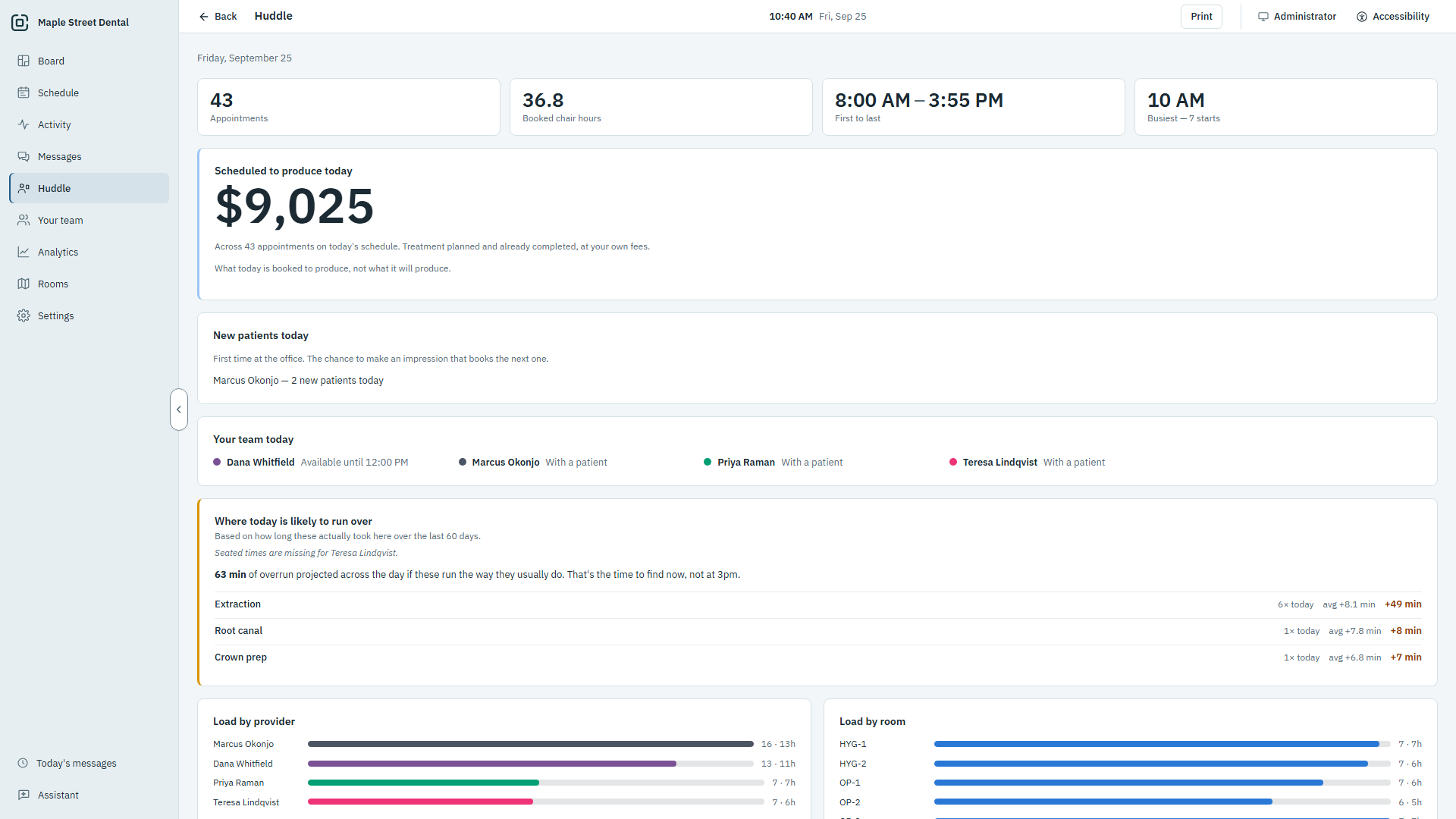
Yesterday’s side of the agenda comes from the same place: how far the day ran behind, turnaround, utilization and idle rooms, kept as history so the trend is real. No patient identifier is stored anywhere in it, which is set out on the security page, and the features that support the daily huddle.
Start tomorrow, with a printed schedule and five fixed numbers. Ten minutes, standing, before the first patient. If the team leaves knowing where the day is likely to break, it worked.